
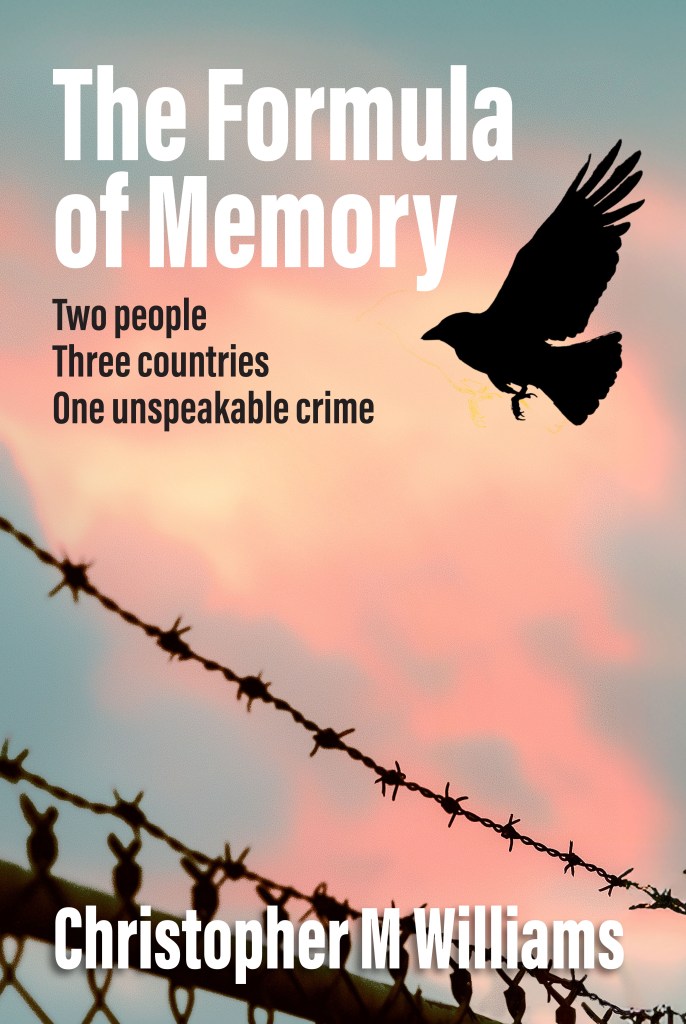
It’s all happening! My debut novel, The Formula of Memory is being released on Amazon tomorrow, October 15. It’s been nearly five years since I wrote the first chapter, I’m excited that the finished, self-published product is getting out there.

The book is available from Amazon, who are really quick with delivery time. It’s also available as an ebook. Just type in The Formula of Memory. I’ll review it here. (Okay, I wrote in my last post I’d outline some innovative teaching techniques but you are not all teachers, so I will spare you).
The Formula of Memory started out over forty years ago as a protest bike ride with the aim of cycling around the world for a nuclear-free future. Fifty two cyclists set off from Parliament House Canberra in March, 1982 and about thirty reached Darwin by July. Then the hard part started. We could not get visas for China (funny that hey, a protest group riding through China?) so four men and three women ended up in Japan. Then, the next year May in Berlin, West Germany. Riding through West Germany (and a large part of The Formula of Memory is set there, but the story in the novel has nothing to do with the bike ride.) The group split up in Hungary and eventually got back together in southern Sweden.

Working on an organic farm – like in Japan – over winter, the group fragmented after winter with a small group of four cycling across Denmark, Germany and The Netherlands ending up in London. We cycled to Scotland, then I left the group to cycle on my own for a week before returning home via Japan. Which leads me into the book. The idea was simmering for years while I raised a family, returned back to Kakadu to work briefly as a Ranger, studied to be a teacher and moved from Kempsey to Broken Hill. The teaching part became almost overwhelming, and the book idea took a back seat as we raised a family and established a new life in Forster, mid-north coast. In the last years before retirement, I completed a few fiction writing courses and began planning the book.
My biggest conundrum was what type of book? A non-fiction account of the bike ride from the dim history of my memory? An autobiographical account of my involvement? Or a novel, with the bike ride as a minor part?
So I chose to write a novel mainly because I wanted to explore themes of love, family, truth, loyalty and friendship told through the eyes of two characters, Daniel and Renate. I also wanted to mention genocide, after visiting Hiroshima and Auschwitz, two places that left me with profound, life-long memories. I organised the book (structure) using the three-act structure, with rising tension, midpoint, falling tension, climax and resolution. It took a lot of time, including the research on the Holocaust and deciding how much to include/exclude.
Which leads me to the publishing process. I wrote the novel chapter by chapter, all 76 of them and linked them together with connecting scenes and themes. I introduced Daniel as a young teacher in outback NSW for three chapters, then switched to Renate in Kassel, West Germany for three chapters and back to Daniel again. This way, I wanted to build up the characters in their own right before they met in chapter 20. They don’t become lovers until the end of the book but they do get married. If you read the book you will understand. I don’t want to spoil it for you here.
So, what is the self-publishing process once the manuscript is finished? I’ll summarise this in point form:
- When you think it is finished, get feedback from at least three other readers or writers. They are called your “beta readers.” They are very important. Be nice to them.
- Make changes, as suggested by your beta readers.
- Send manuscript to a developmental editor. This costs money, anywhere from $900 to $2000 depending on the word count. It’s worth it.
- Make changes (re-write sections, delete sections) as suggested by your editor.
- Have your best beta reader review your changes and re-write (if necessary).
- Find a formatting expert (or do it yourself, if you feel confident in this technical aspect, which I don’t, so I paid for this). Get it formatted properly.
- Send formatted file (now in PDF form) to a proofreading editor (yes, I paid for this valuable service too.)
- Make changes as suggested and discussed with the proofreader.
- Send the changes back to the formatter, who will make the changes in the PDF file.
- When returned, check over the file before opening an Amazon KDP account. (yay, this is free!)
- Download the finished file to Amazon KDP. This may(?) require some help.
- Order a “Proof Copy” and check it over carefully for mistakes, usually there will be some formatting mistakes.
- Send back the file to the formatter to correct the mistakes.
- Upload a corrected file to Amazon KDP.
- Finalise release date with Amazon KDP.
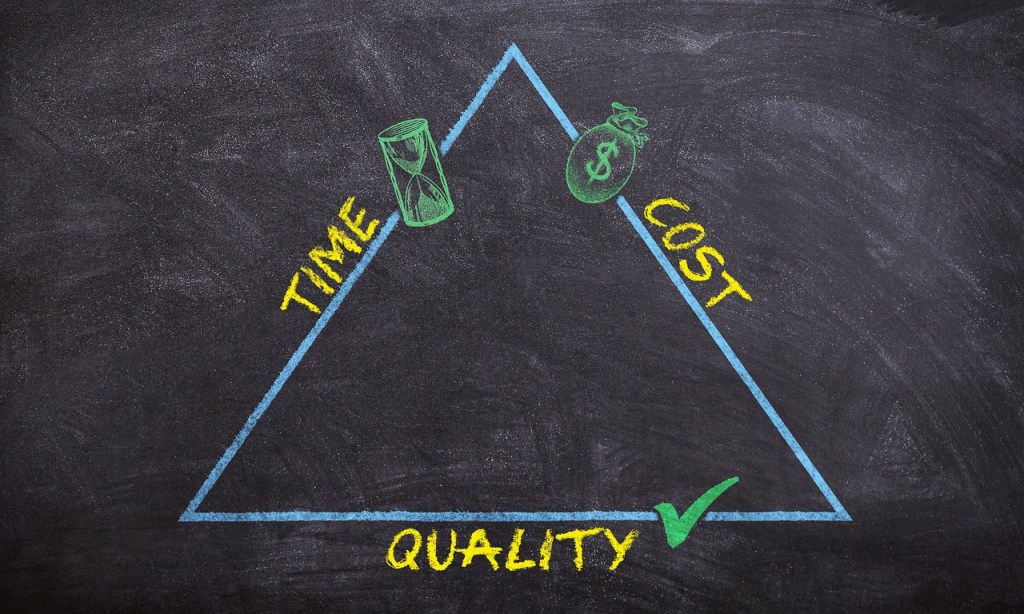
Is there another pathway to publishing? You can try to get an agent who will try to get a major publishing house to look at your manuscript but, if you are not well known with a long publishing history, this is extremely difficult. I tried hard for six months to secure an agent. I contacted every known agent in Australia and received rejections. No publisher I contacted was interested. Thus, the only avenue open to me was to self-publish. At least this way, I had total control over the design and layout and I keep a better share of the sales (if any?). I think self-publishing is the way of the future.
That’s about all I’ll scare you with now. It’s all worth it when your finished book turns up at your door. Now you just have to sell it and market it!
I hope I haven’t turned anyone off writing. Yes, publishing a novel is daunting the first time. But, again, isn’t any new career challenging when you first start out? The writing part seems easy looking back. But there’s time management and distractions to avoid here as well.
In the end, I’m glad I did it. I have something physical like a legacy to show people and hopefully you and they will enjoy reading the story.
I hope this helps. Thanks for reading.
 WordWheelsWrites from the author Christopher Williams
Leave a comment